
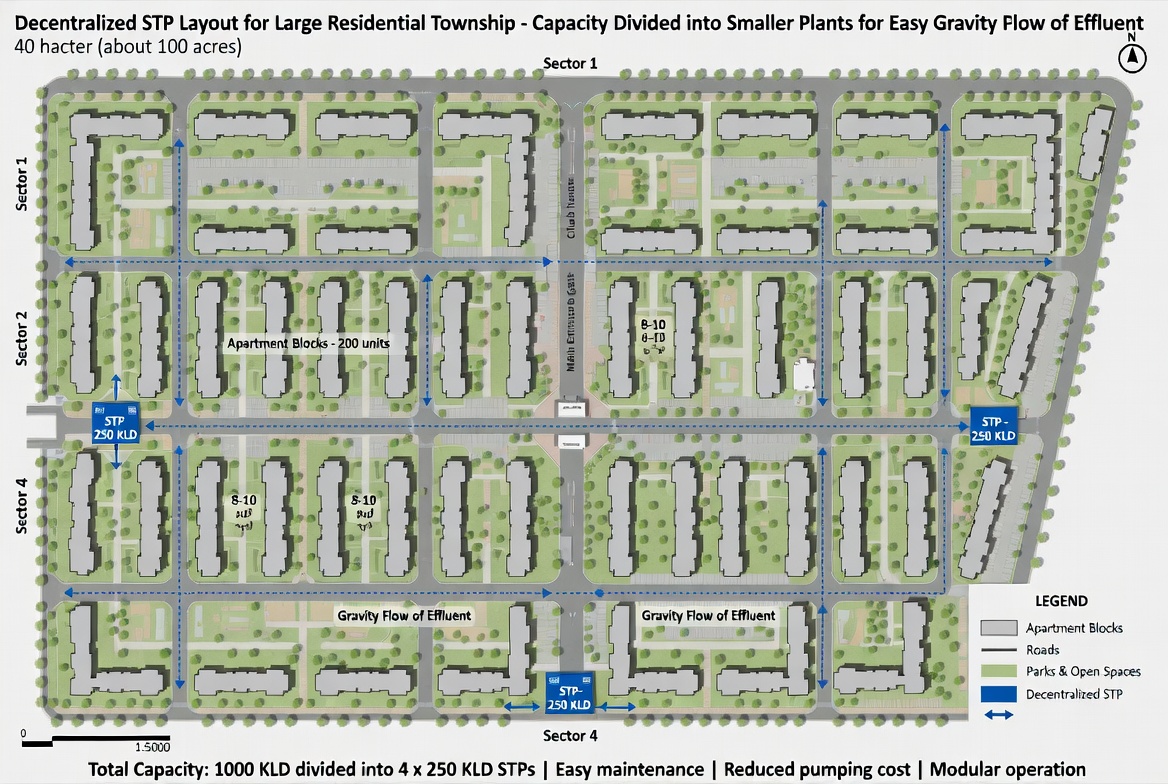
Welcome back to the blog! This week, we’re diving into a topic that blends smart engineering with sustainable living: split sewage treatment plants designed to handle bigger residential layouts. If you’re planning a large residential development or simply curious about efficient wastewater management in sprawling communities, you’re in the right place.
Let’s unpack why splitting sewage treatment capacities can be a game changer for bigger housing projects and how this approach not only helps curb costs but also promotes environmental friendliness and operational flexibility.
The Slope and Piping size matter. The Slope will not be sufficient to transport effluents.
And extreme locational plots will face issues
Dividing the total STP (Sewage Treatment Plant) capacity into multiple smaller (decentralized or modular) plants — instead of building one large centralized STP — is a common and often recommended approach for large residential townships, gated communities, or housing societies (especially in India and similar developing regions). This approach is not always “mandatory,” but it is necessary or highly advantageous in most real-world large layouts for several practical, economic, operational, and environmental reasons.
Here are the main reasons why splitting capacity (e.g., 1000 KLD total → 4 × 250 KLD plants) is preferred
Gravity flow becomes practical and energy-efficient
Massive reduction in underground infrastructure cost
Easier & cheaper maintenance and operation
Phased / modular expansion matches real development
Better land use and layout flexibility
Environmental & regulatory advantages
#SewageTreatmentPlant #STPDesign
#STPLayout #ResidentialSTP
#WastewaterTreatment #STPSolution
#WaterTreatmentPlant #EffluentTreatment
#SewageTreatment #WastewaterPlant
#STPDesign #ResidentialSTP
#STPLayout #STPSolution
#ResidentialSTP #NagprSTP
#NMRDAlayoutSTP #watermanagement
#wastewaterreuse #waterrecycling
#STPMaharashtra #PuneSTP