
Welcome back to the blog! This week, we’re diving into a topic that blends smart engineering with sustainable living: split sewage treatment plants designed to handle bigger residential layouts. If you’re planning a large residential development ,or simply curious about efficient wastewater management in sprawling communities, you’re in the right place.
Let’s unpack why splitting sewage treatment capacities can be a game changer for bigger housing projects , and how this approach not only helps curb costs but also promotes environmental friendliness and operational flexibility.
The Slope and Piping size matters , Slope will not be sufficient to transport effluents
And extreme locational plots will face issues
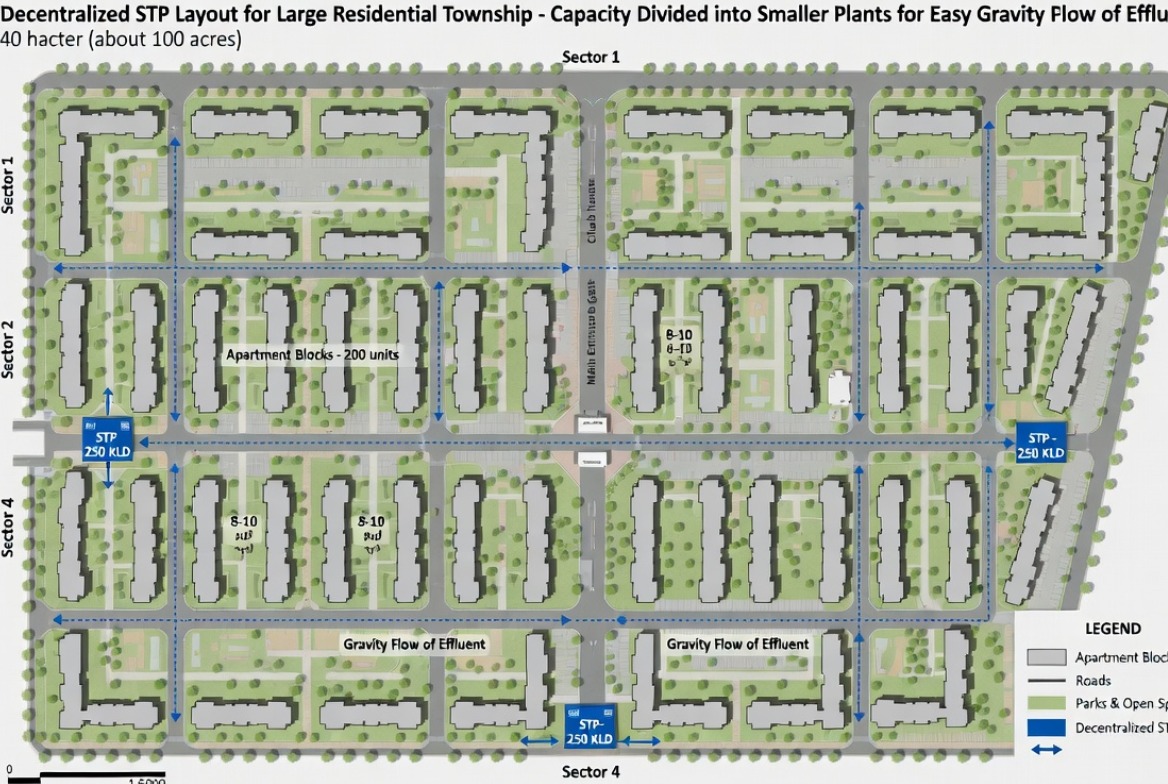
Dividing the total STP (Sewage Treatment Plant) capacity into multiple smaller (decentralized or modular) plants — instead of building one large centralized STP — is a common and often recommended approach for large residential townships, gated communities, or housing societies (especially in India and similar developing regions). This is not always “mandatory,” but it is necessary or highly advantageous in most real-world large layouts for several practical, economic, operational, and environmental reasons.
Here are the main reasons why splitting capacity (e.g., 1000 KLD total → 4 × 250 KLD plants) is preferred:
- Gravity flow becomes practical and energy-efficient. In a large township (20–100+ acres), the site usually has natural slopes and varying elevations.
- A single central STP requires collecting sewage from distant/far-away blocks → long sewer lines + multiple pumping stations (lift stations) to push effluent uphill or over long distances.
- Smaller STPs placed at low points in each sector allow almost entire collection via gravity sewers (cheaper pipes, no or minimal pumping). → Saves huge electricity costs (pumps are one of the biggest O&M expenses in STPs) and reduces breakdown risk.
- Massive reduction in underground infrastructure cost Collection & conveyance networks (sewer pipes, manholes, pumping mains) often account for 50–75% of total project cost in centralized systems.
- Decentralized layout needs only short, small-diameter gravity sewers per sector.
- No long, deep, expensive trunk sewers or high-capacity pumps. → Lower capital cost (CAPEX), faster construction, less disruption during laying pipes.
- Easier & cheaper maintenance and operation
- Smaller plants (200–500 KLD) are simpler to operate, monitor, and repair.
- If one unit needs shutdown/maintenance/repair, only ~25% of the township is affected → rest continues normally (high resilience).
- In one large plant, any major failure stops the entire system → big risk of overflow/ pollution complaints.
- Staffing, chemicals, desludging, and blower maintenance are easier to manage in smaller modules.
- Phased/modular expansion matches real development. Townships are built in phases (sectors added over 3–10 years).
- You install STPs only for occupied/completed sectors first → avoid investing in oversized central plants early.
- Add more small plants later as the population grows → perfect cash flow and land utilization.
- Better land use and layout flexibility
- Small STPs need less space (compact MBBR/SBR/MBR units fit in 500–1500 m² per 250 KLD).
- Can be placed in corners, near boundary walls, or green belts without wasting prime saleable land.
- One huge central STP (often 3000–8000 m² for 1000+ KLD) eats valuable developable land.
- Environmental & regulatory advantages
- Less pumping → lower carbon footprint and energy use.
- Treated water reuse (flushing, gardening, cooling towers) is easier locally per sector, which reduces freshwater demand.
- Easier to meet stricter discharge/reuse norms (CPCB/MPCB) because failures are localized.
- Many state pollution boards and green building ratings (IGBC/LEED) now encourage decentralized systems.
Quick Comparison Table
| Aspect | Single Large Centralized STP | Multiple Smaller Decentralized STPs |
| Sewer Infrastructure | Very high cost (long pipes + pumps) | Low cost (mostly gravity, short lines) |
| Energy for pumping | High | Very low |
| Maintenance impact | The entire township affected if there is a failure | Only local sector affected |
| Initial CAPEX | High (oversized early) | Lower & phased |
| Scalability | Difficult/expensive to expand | Easy—add modules |
| Land requirement | Large single plot | Distributed, smaller footprints |
| Risk of total system failure | High | Low |
Bottom line (for large residential layouts >20–30 acres / 500+ units): One big STP is technically possible but usually economically and operationally disadvantageous. Dividing into 3–6 smaller plants (sector-wise or 200–400 KLD each) is the modern, practical standard in India for new townships—especially when gravity flow is prioritized.
If your project has very flat land, extremely high density in one compact area, or an existing municipal sewer connection nearby, then centralized might still make sense — but that’s the exception, not the rule.
Let me know your township size, approximate total sewage flow, or topography details if you want more specific advice!
SAMPLE :- STP CAPACITY ESTIMATION
| Sr No | STP NO | Surrounded KH. No and Roads | Total No of Plots | Total No of Soul @6 Nos. per Plot | Total Waste Water Generated@135/lpcd | 10 % transportation loss | NET STP CAPACITY |
| 1 | 1 | 54,51 and 12 M Wide Road | 225 Nos. | 1350 Nos. | 182,250 Lit | 18,225 lit | 165 KLD |
| 2 | 2 | 43,38 and 12 m wide road | 120 Nos. | 720 Nos. | 97,200 Lit | 9720 lit | 90 KLD [ 87480 lit] |
| 3 | 3 | 38 , Road 12 ,15,9 MTR | 65 Nos. | 390 Nos. | 52,650 Lit | 5265 Lit | 50[47,385lit] |
| 4 | 4 | 30 ,32 part 26Roads 15,9 MTR | 146 Nos. | 876 Nos. | 118,260 Lit | 1182 Lit | 120 KLD [117078] |
| 5 | 5 | 29/1 [part] 23/2 ,23/1,25 | 279 Nos. | 1674 | 225,990 Lit | 22599 Lit | 200 KLD[203391] |
| TOTAL | 5 Nos. STP | 835 PLOTS | 5010 NOS | 676350 LIT | 676,350 Lit | 625 KLD | |
#SewageTreatmentPlant #STPDesign
#STPLayout #ResidentialSTP
#WastewaterTreatment #STPSolution
#WaterTreatmentPlant #EffluentTreatment
#SewageTreatment #WastewaterPlant
#STPDesign #ResidentialSTP
#STPLayout #STPSolution
#ResidentialSTP #NagprSTP
#NMRDAlayoutSTP #watermanagement
#wastewaterreuse #waterrecycling
#STPMaharashtra #PuneSTP